
Insights
Excel vs Power BI Is the Wrong Fight. Here's What Finance Should Keep
Excel vs Power BI is the wrong fight for mid-market finance. Keep shared actuals in Power BI and models and statements in Excel, connected, not pasted.
IT wants Power BI. Finance still closes in Excel. The board wants one number. That is not a contradiction. It is how mid-market finance actually works.
People search “Power BI vs Excel for financial reporting” and “should we replace Excel with Power BI.” The mistake is treating that question as a replacement decision. Kill Excel and you starve modeling and formatted statements. Keep everything in Excel and you never get shared, refreshable actuals. The fight is false. The split is real.

The problem
Finance does two jobs under one word, reporting.
Shared actuals. This is what we booked, with the same definition for the CFO, the plant, and the pack. That number should not live in an email attachment.
Judgment work. Forecasts, scenarios, cell-level models, and a P&L that has to look like last quarter’s because the committee will line them up. That work is still Excel.
A Power BI project that tries to do both usually fails the second job. An Excel file that tries to do both usually fails the first. You feel it as pasting, a dashboard nobody trusts, and a meeting that starts with “which file is right.”
If the team is still copying ERP extracts into workbooks, that is the reporting drag described in How Power BI Consulting Solves Finance Reporting Pain Points. This piece covers the other half: what not to rip out.
The costs of the false fight
-
Two versions of actuals. Ops has a dashboard and finance has a workbook. Neither is lying. Grain, timing, and exclusions differ. Conflicting numbers are a governance problem, not a chart problem. See The Hidden Costs of Poor Power BI Governance.
-
The close still waits on pasting. Power BI went live, and someone is still exporting and then typing. The tool changed. The bottleneck did not.
-
Models get worse, not better. Teams force a three-statement model or a board layout into Power BI because “we’re standardizing.” DAX is the wrong place for cell-level scenario work. That is a design mismatch, and a week of training will not fix it.
-
Trust dies in the executive meeting. The first time the dashboard and the controller’s pack disagree, leaders stop using both and ask for a spreadsheet.
-
Shadow Excel comes back. If finance cannot format, annotate, and model in a tool it owns, it rebuilds actuals off to the side. You paid for a platform and kept the version-control problem.
What to keep in Excel vs what belongs in Power BI
Keep Excel for work that is constructed, not merely displayed.
- Modeling. Budgets, forecasts, what-if, and capital cases. Power BI is not a modeling grid.
- Formatted statements. Department P&Ls, consolidations, trial-balance tie-outs, and board packs that must match last quarter’s layout.
- Commentary and adjustments. Narrative and one-off reclasses, in a workbook with an owner and a date.
Put Power BI on work that must be shared, current, and the same for everyone.
- Actuals the company will argue from. One semantic model and one set of measures, refreshed on a cadence finance agrees to.
- Cross-functional views. Plant, region, and product, with drill-down that does not need a new extract.
- Access you can defend. Role-based views beat a workbook forwarded to the wrong inbox.
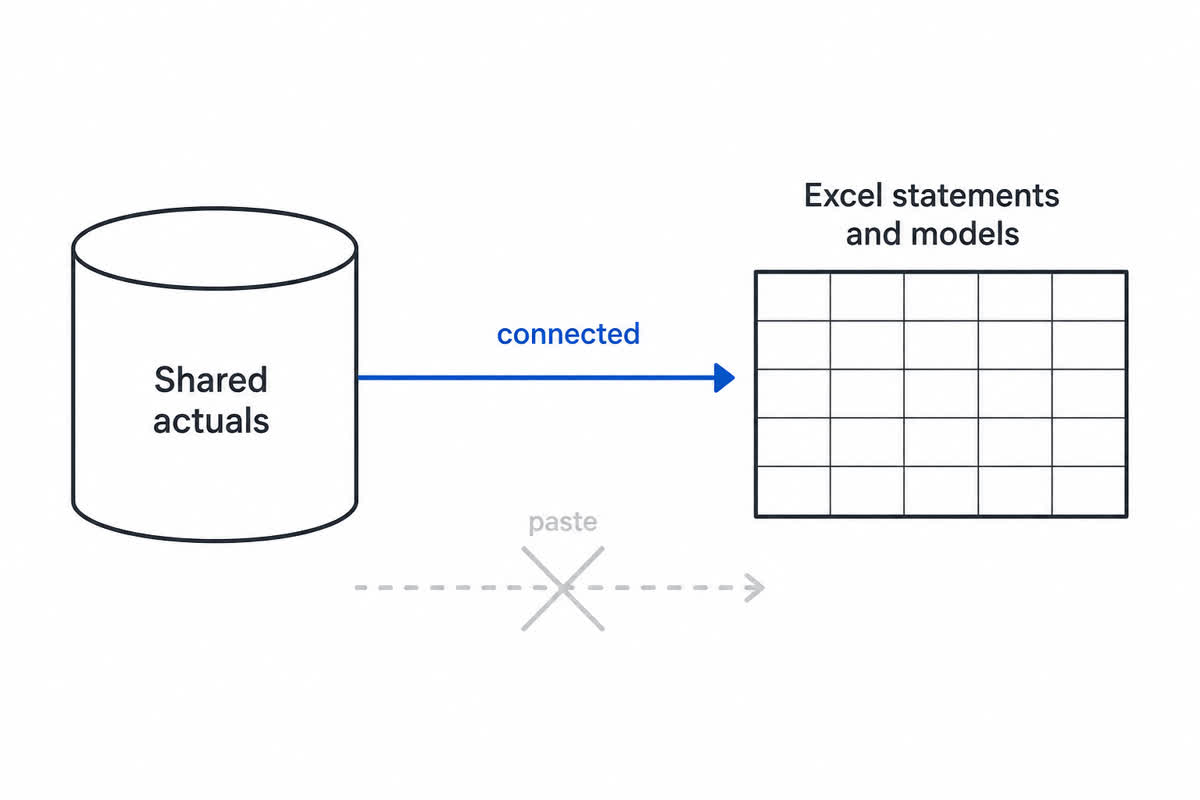
Excel is not the enemy. Pasted actuals are.
Microsoft documents a real pattern for this: Excel connected to a Power BI semantic model (Analyze in Excel). What matters for a CFO is not the ribbon. It is that actuals refresh from the model while the workbook stays Excel.
| Keep in Excel | Put in Power BI |
|---|---|
| Models, scenarios, sensitivity | Shared actuals and KPIs |
| Formatted statements and board packs | Interactive views for the rest of the business |
| Commentary and owner files | One definition of the number, with access control |
| Connected to the model | Source of the actuals the workbook uses |
If the workbook is still an ERP dump, you renamed the export. You did not make the split.
How to fix it (without a steering committee)
You do not need a six-month “Excel exit.” You need a boundary, then one working loop.
-
Name the official actuals. One model, one owner, one refresh window. Write down what “revenue” includes. If two dashboards already disagree, fix that first, starting with the metric leadership already fights about.
-
Stop using Power BI as a statement printer. Paginated, annotated packs that must tie to the GL layout stay in Excel. Power BI feeds the pack. It does not impersonate it.
-
Connect the pack instead of pasting it. Point working files at the semantic model. If someone still copies values, that is a process break, not a training slide.
-
Leave modeling in Excel on purpose. When a scenario needs actuals, pull them from the model. Do not rebuild the forecast in DAX because a roadmap said “all finance in Power BI.”
-
Inventory the dangerous workbooks. Not every file, just the five that hit the ELT or the board. Note who owns each and whether it pastes or connects, and retire last month’s extract hiding under a new tab name. It is the same instinct as sunsetting abandoned reports in Power BI governance.
-
Prove it on one loop. Build one P&L (or cash view) in Power BI and one connected Excel pack, and run one week of the same actuals in both. If that loop still pastes, do not scale it. Slow or unused models are a separate job for dashboard optimization.
If you cannot tell a decision metric from a close artifact, that is a strategy problem, not a license upgrade. See the Data & AI Strategy Roadmap. Ongoing ownership of definitions and refresh is what Managed Data & AI Advisory covers.
Frequently asked questions
Should we replace Excel with Power BI? No. Replace pasted actuals. Keep Excel for modeling and formatted statements, and use Power BI as the shared actuals layer.
Can Power BI produce our board package? It can show the same actuals, but it is usually the wrong place for pixel-precise, commentary-heavy statements. Keep the pack in Excel, connected to the model.
How do we keep Excel and Power BI from drifting? Do not maintain two copies of actuals. Keep one semantic model and let Excel consume it. Drift starts when someone pastes.
Do we need a new platform to connect them? Not for this pattern. Microsoft already documents Excel connected to Power BI semantic models, and ERP Excel add-ins are optional. Start there before you shop. The split also holds on ERPs other than Business Central.
Get started with Alluvium
You do not need to pick a winner. You need a clean actuals layer and Excel that consumes it.
Want to see where your numbers still get pasted? Book a session. We’ll map one actuals source and one workbook that should connect to it, not a replacement program. Or start with a free Model Health check.
Next step
Book a Session
Need a clearer finance or executive reporting stack? Book a Session.